Reconstruction & sheet metal
Two JSON-driven composition verbs that build BREP geometry without a script file: reconstruct turns a [FeatureSpec] list into a solid; compose-sheet-metal folds flanges and bends into a sheet-metal part. Both read from stdin or a file path and write a BREP under outputDir. See Composition reference for every field.
1. reconstruct — feature list → BREP
reconstruct drives OCCTSwift.FeatureReconstructor.buildJSON (v0.147+). The request envelope is a JSON object with four keys: outputDir, outputName (optional; default "reconstructed"), inputBrep (optional; see below), and features — an array of feature entries, each identified by a kind discriminator.
Minimal example: revolve then drill
cat > /tmp/shaft.json <<'EOF'
{
  "outputDir": "/tmp/out",
  "outputName": "shaft",
  "features": [
    {
      "kind": "revolve",
      "id": "body",
      "profile_points_2d": [[0,0], [12,0], [12,60], [0,60]],
      "axis_origin":    [0, 0, 0],
      "axis_direction": [0, 0, 1],
      "angle_deg": 360
    },
    {
      "kind": "hole",
      "id": "centre_hole",
      "center":    [0, 0, 0],
      "direction": [0, 0, 1],
      "radius": 4,
      "depth": 60
    }
  ]
}
EOF
occtkit reconstruct /tmp/shaft.json
{
  "shape": "/tmp/out/shaft.brep",
  "fulfilled": ["body", "centre_hole"],
  "skipped": [],
  "annotations": []
}
Exit code 0 means every feature was fulfilled. Exit code 2 means no features could be built (partial builds where some features succeed still return 0; check skipped for details).
Editing an existing body (inputBrep / @input)
Supply inputBrep to seed the build context with an existing solid. Hole, fillet, and chamfer entries cut directly into it. Use a boolean entry with "left": "@input" for non-circular pockets or any operation that needs to name the seed body explicitly:
{
  "outputDir": "/tmp/out",
  "outputName": "shaft_v2",
  "inputBrep": "/tmp/out/shaft.brep",
  "features": [
    {
      "kind": "fillet",
      "id": "top_fillet",
      "edges": ["edge:0", "edge:1"],
      "radius": 1.5
    },
    {
      "kind": "boolean",
      "id": "keyway",
      "op": "subtract",
      "left": "@input",
      "right": "keyway_tool"
    }
  ]
}
The boolean kind (op: "union" | "subtract" | "intersection") was added in OCCTSwift v0.152.1 and requires both operands to already exist as named solids in the build context; "@input" is the sentinel for the seeded body.
Available feature kinds
kind | Key fields |
|---|---|
revolve | profile_points_2d, axis_origin, axis_direction, angle_deg |
extrude | profile_points_2d, direction, length |
hole | center, direction, radius, depth |
thread | spec, hole_ref, length (optional) |
fillet | edges, radius |
chamfer | edges, distance |
boolean | op, left, right |
Every entry also carries an id string used in fulfilled / skipped / cross-references. See the Composition reference for the full field list.
2. compose-sheet-metal — flanges + bends → folded part
compose-sheet-metal drives OCCTSwift.SheetMetal.Builder (v0.151+). Each face of the part is a Flange — a 2D profile placed in 3D by an origin, an in-plane uAxis (and optional vAxis), and a normal along which thickness is extruded. Bends round the shared edges between adjacent flanges.
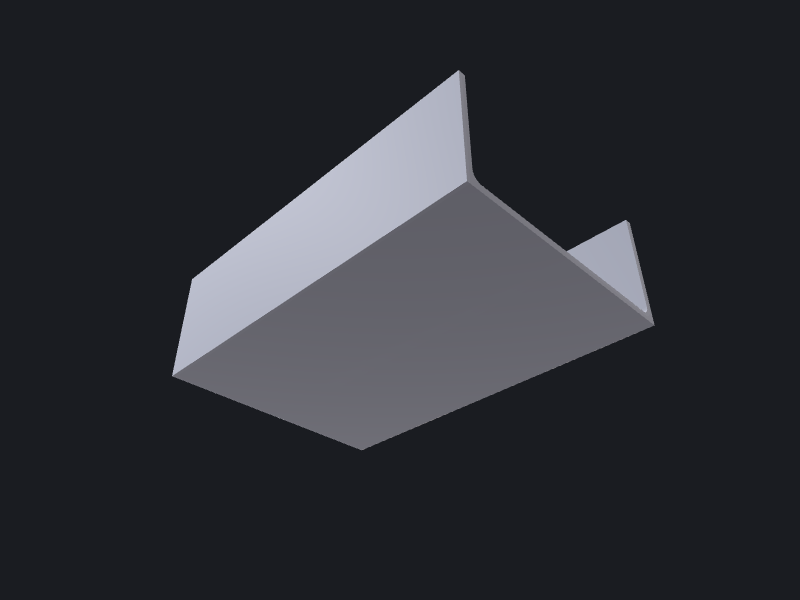
The U-channel (worked example)
A base plate with two walls bent up on opposite long edges — the canonical robust part for this builder.
cat > /tmp/channel.json <<'EOF'
{
  "outputDir": "/tmp/out",
  "outputName": "u_channel",
  "thickness": 1.5,
  "flanges": [
    {
      "id": "base",
      "profile": [[0,0],[80,0],[80,50],[0,50]],
      "origin": [0, 0, 0],
      "uAxis":  [1, 0, 0],
      "vAxis":  [0, 1, 0],
      "normal": [0, 0, 1]
    },
    {
      "id": "front",
      "profile": [[0,0],[80,0],[80,25],[0,25]],
      "origin": [0, 0, 0],
      "uAxis":  [1, 0, 0],
      "vAxis":  [0, 0, 1],
      "normal": [0, -1, 0]
    },
    {
      "id": "back",
      "profile": [[0,0],[80,0],[80,25],[0,25]],
      "origin": [0, 50, 0],
      "uAxis":  [1, 0, 0],
      "vAxis":  [0, 0, 1],
      "normal": [0, 1, 0]
    }
  ],
  "bends": [
    {"from": "base", "to": "front", "radius": 2.0},
    {"from": "base", "to": "back",  "radius": 2.0}
  ]
}
EOF
occtkit compose-sheet-metal /tmp/channel.json
{
  "shape": "/tmp/out/u_channel.brep",
  "flanges": 3,
  "bends": 2
}
Builder limitations
Keep these in mind when authoring specs:
- Always set
vAxisexplicitly on walls. The defaultcross(normal, uAxis)points downward for some edge orientations, folding the wall below the base and causing the bend fillet to fail. - Walls must span the full shared edge. Corner relief cutouts or inset origins cause the bend fillet to fail — the builder rounds the entire shared edge.
- No shared corners. The builder handles chains and opposite flanges (U-channel, Z-bracket) but not two walls that meet at a corner. A four-wall tray or closed box is not buildable today. A U-channel is the reliable canonical part.
buildthrowsSheetMetal.BuildError. It isCustomStringConvertible; surface and log its message rather than force-unwrapping.
See the Composition reference for the full field table.