Sweeps, lofts & patterns
Three techniques that take a simple primitive and multiply it into a complex solid: pipe sweeps drag a cross-section along a 3D path; lofts skin a surface across a stack of placed profiles; linear patterns tile a body along one or more axes and fuse the copies. Each sub-recipe below is a worked example drawn from the recipes/ folder — run the exact command shown to reproduce the output.
1 — Helix + pipe sweep (helical spring)
Recipe: recipes/02-helical-spring/
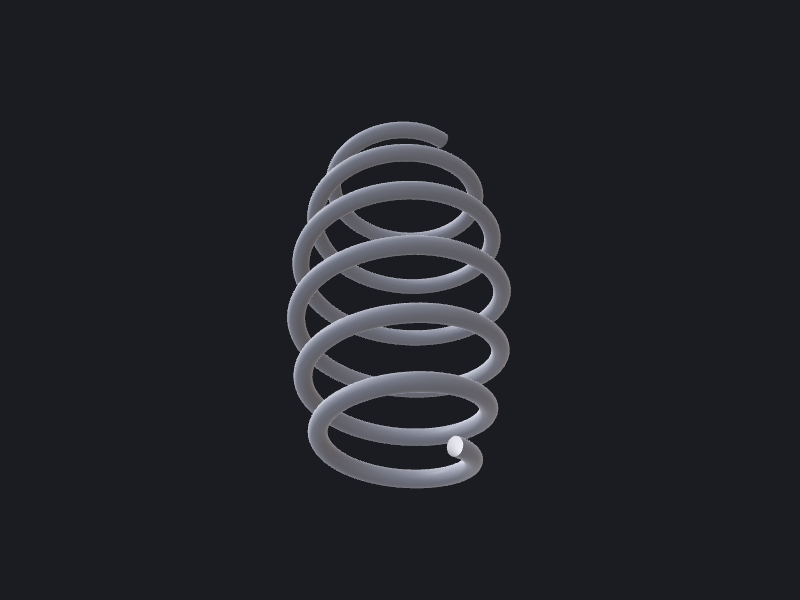
A constant-pitch compression spring: Wire.helix gives the coil centre-line; a circle placed at its start point (oriented along the helix tangent) is swept along the path with Shape.sweep, which wraps BRepOffsetAPI_MakePipe.
// Coil centre-line about Z
let path = Wire.helix(radius: meanRadius, pitch: pitch, turns: activeCoils)!

// Section at the helix start, facing along the start tangent
// Helix tangent at θ=0: (0, R, pitch/2π), normalised
let t = SIMD3<Double>(0, meanRadius, pitch / (2 * .pi))
let tLen = (t.x*t.x + t.y*t.y + t.z*t.z).squareRoot()
let tangent = t / tLen
let section = Wire.circle(origin: SIMD3(meanRadius, 0, 0),
                          normal: tangent, radius: wireDia / 2)!

let spring = Shape.sweep(profile: section, along: path)!
Run it:
swift run occtkit run recipes/02-helical-spring/main.swift --format brep
Gotchas
- The section circle must sit on the spine start and face along the tangent — an edge-on or offset section makes
BRepOffsetAPI_MakePipefail and returnsnil. Shape.sweeporientation-normalises its result since OCCTSwift v1.3.1 (issue #170), so you never need to flip the section sense to avoid a negative-volume solid. UseShape.signedVolumeif you need to inspect raw orientation.Wire.helixtakesturns:(a coil count), not aheight:. Free length ≈pitch · turns.- Ground or closed ends are out of scope here — they require a variable-pitch helix or an end-grinding boolean.
2 — Lofted twisted sections (fan blade)
Recipe: recipes/06-fan-blade/
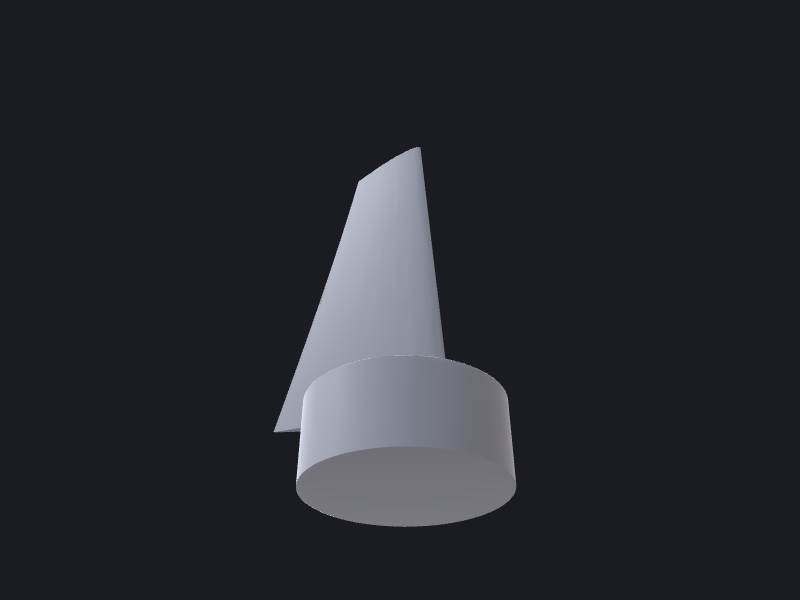
A tapered, twisted fan blade: six NACA-symmetric airfoil cross-sections are built at spanwise stations, each scaled by the chord taper and rotated by the interpolated twist angle, then skinned into a solid with Shape.loft (BRepOffsetAPI_ThruSections). A hub cylinder is fused on at the root.
// Build one Wire per spanwise station: scale (taper) + rotate in-plane (twist)
for i in 0..<sections {
    let f = Double(i) / Double(sections - 1)
    let chord = rootChord * (1 - taper * f)
    let twist = (twistRootDeg + (twistTipDeg - twistRootDeg) * f) * .pi / 180
    let pts3d = baseAirfoil.map { p -> SIMD3<Double> in
        let sx = p.x * chord, sy = p.y * chord
        return SIMD3(sx * cos(twist) - sy * sin(twist),
                     sx * sin(twist) + sy * cos(twist),
                     f * span)
    }
    profiles.append(Wire.polygon3D(pts3d, closed: true)!)
}

guard var blade = Shape.loft(profiles: profiles, solid: true) else { fatalError("loft failed") }

// Hub boss fused at the root
let hub = Shape.cylinder(at: SIMD3(0, 0, -12), direction: SIMD3(0, 0, 1),
                         radius: rootChord * 0.55, height: 14)!
blade = blade.union(hub) ?? blade
Run it:
swift run occtkit run recipes/06-fan-blade/main.swift --format brep
Gotchas
- Loft matches profiles by vertex index. Every section must have the same point count in the same winding order. Generate all sections from one base loop and only transform the points — mismatched counts produce twisted or torn surfaces.
- Keep the trailing edge slightly open (the NACA TE is non-zero by formula). Coincident upper/lower TE points degenerate the wire.
- Large twist deltas across few sections can cause the loft to self-intersect. Add more
sectionsif a steeply twisted blade fails or pinches. - A full rotor is this blade repeated with
circularPatternabout the hub axis.
See the Construction reference for the loft verb’s ruled and lastVertex options.
3 — Linear pattern + union (strut lattice)
Recipe: recipes/05-lattice-cube/
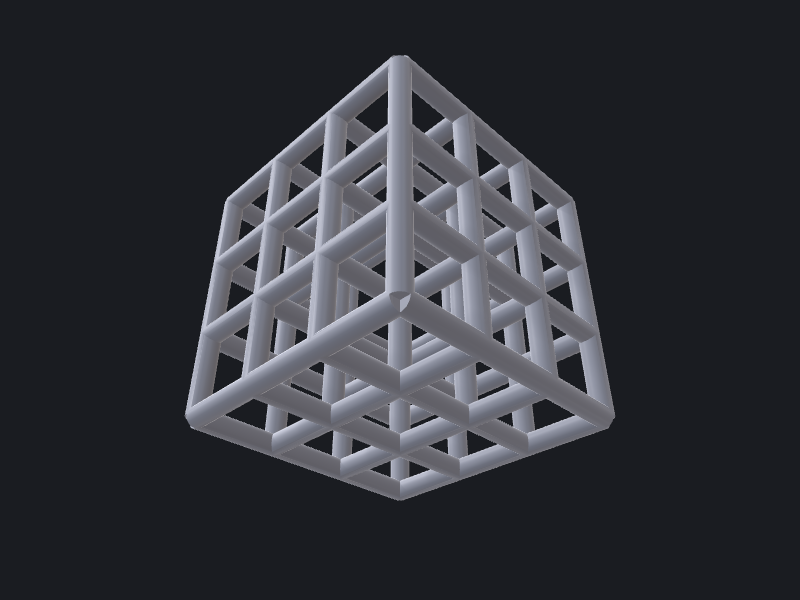
A 3D-printable cubic strut lattice: for each axis, one full-length rod cylinder is built, tiled into a grid by two chained Shape.linearPattern calls, and the three rod grids are fused with Shape.union into a single watertight solid.
// One full-length rod per axis; two chained patterns tile a grid
func rodGrid(axis: SIMD3<Double>, tileA: SIMD3<Double>, tileB: SIMD3<Double>) -> Shape {
    let rod = Shape.cylinder(at: .zero, direction: axis, radius: strutR, height: span)!
    let row = rod.linearPattern(direction: tileA, spacing: cell, count: lines)!
    return row.linearPattern(direction: tileB, spacing: cell, count: lines)!
}

let xRods = rodGrid(axis: SIMD3(1,0,0), tileA: SIMD3(0,1,0), tileB: SIMD3(0,0,1))
let yRods = rodGrid(axis: SIMD3(0,1,0), tileA: SIMD3(1,0,0), tileB: SIMD3(0,0,1))
let zRods = rodGrid(axis: SIMD3(0,0,1), tileA: SIMD3(1,0,0), tileB: SIMD3(0,1,0))

let lattice = xRods.union(yRods)!.union(zRods)!
Run it:
swift run occtkit run recipes/05-lattice-cube/main.swift --format brep
Gotchas
linearPatternis 1D — tile a 2D grid by chaining two calls on the result.- Use full-length rods (spanning the whole lattice) rather than per-cell segments. Per-cell segments accumulate coincident faces at every node, making the union slower and more fragile.
- Cost scales with
(cells+1)² × 3cylinders plus the final fuse — keepcellsat 3–5 for fast iteration; large lattices fuse slowly. - This is a simple cubic (rods-only) lattice. Body-centred (BCC) or octet cells add diagonal struts — sweep them along
Wire.linediagonals and union them the same way.
See the Construction reference for linearPattern and circularPattern flag details.